
Play Hexagonal Chess Against AI
How to Play Gliński Hexagonal Chess
Gliński hexagonal chess sets familiar pieces on a 91-cell hex board. Rooks move on six straight lines, bishops cover the board's three colours between them, and pawns move straight ahead but capture at 60°. Choose an AI level, pick a side, and start playing.
How a Game Begins
The board is a hexagon of 91 cells in three shades. Kings, queens, rooks, knights, and bishops keep their usual roles, but the geometry changes: rooks slide along edges, bishops along vertices, and knights jump to a nearby hex. Each side has three bishops, one on each colour.
Pawns move straight forward and capture on the two 60° forward diagonals. Any pawn still on its starting cell may advance two hexes, and en passant applies after that double step. A pawn that reaches the end of its file promotes to a queen. There is no castling. Checkmate wins; if a player has no legal move but is not in check, Gliński awards the win to the side that just moved.
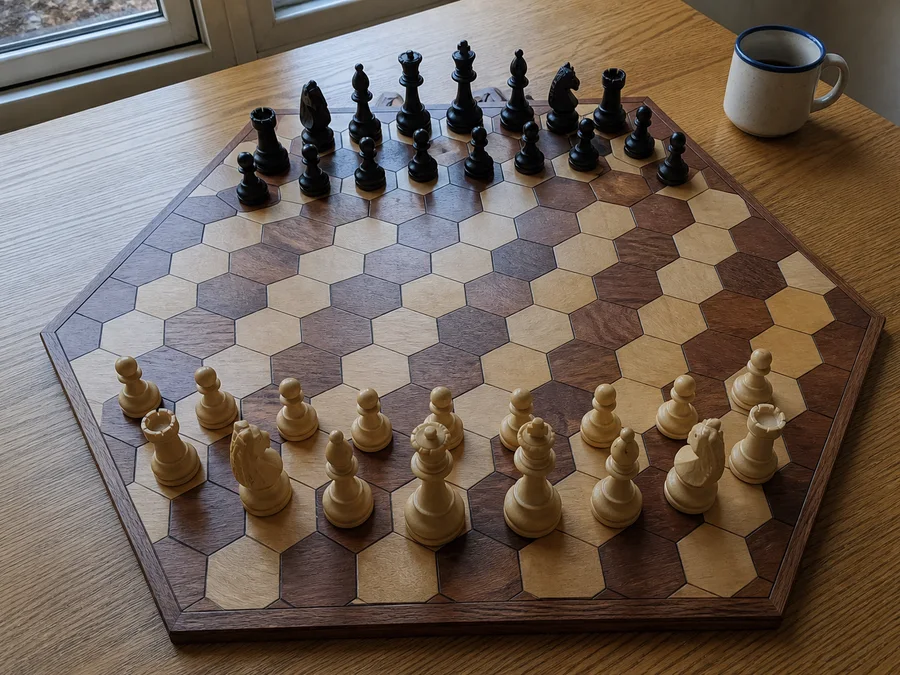
Opening Files Run Long
Before spending the central pawn's double step, check which colour each bishop controls and which file you are opening. Files run farther here than they do on a square board, so a wasted tempo in the opening often matters more than a quiet trade.
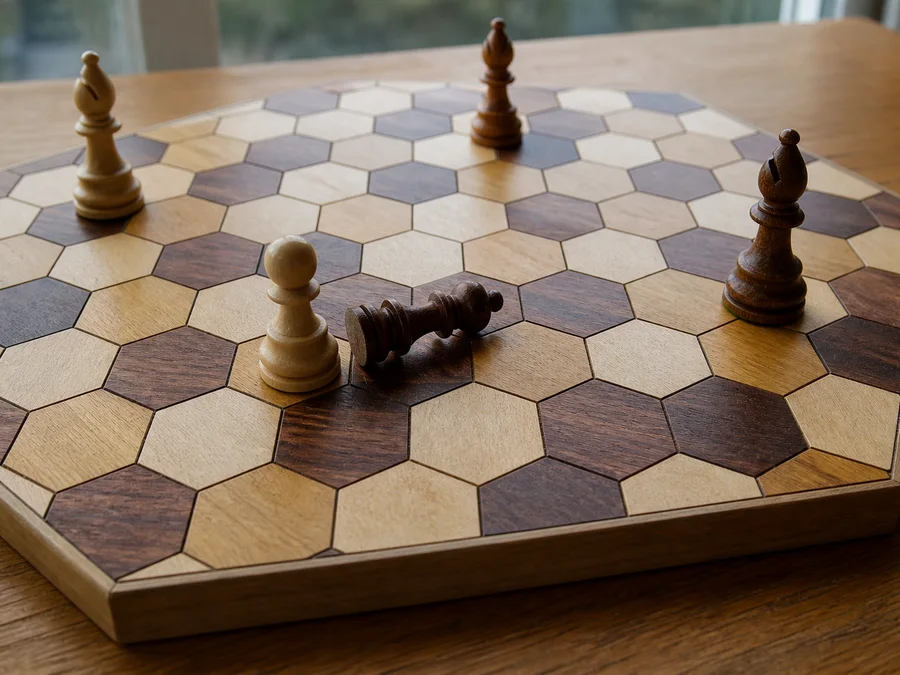
Pawns Capture at 60°
Pawns never move diagonally unless they are capturing. The opening double step is available from any starting cell, not just a second rank. After Black plays c7 to c5, a White pawn on b5 may capture en passant on c6. Promotion comes at the end of the file, and this site promotes to a queen automatically.
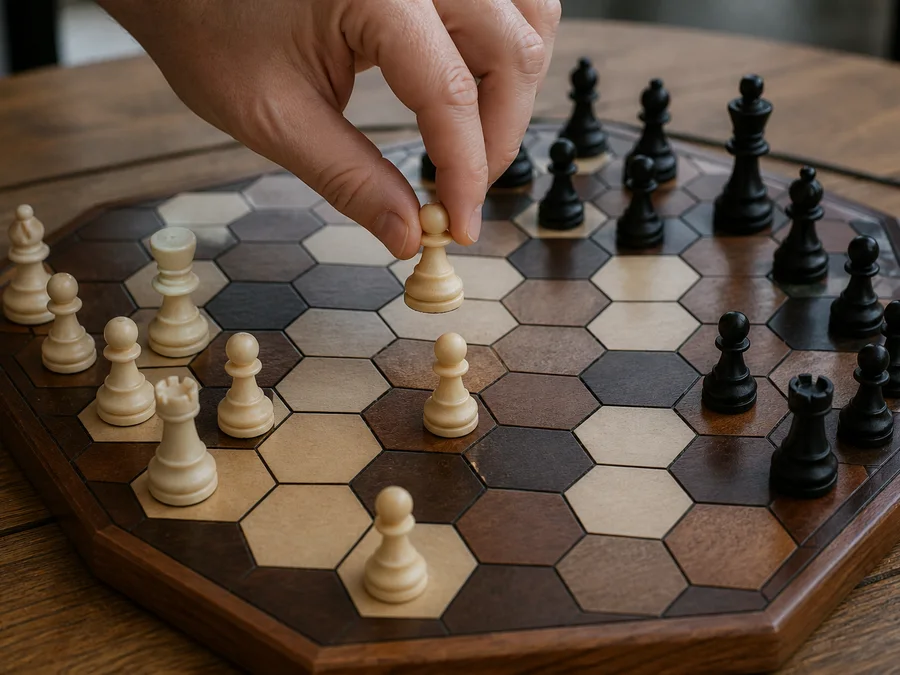
Hints Follow Your AI Level
Choose from multiple AI levels, then play as White to open or as Black to answer. Hints use the same level you selected, and undo rolls back both your move and the AI reply. After the game, replay the moment a file opened or the mating net tightened. All AI calculation runs in your browser.
91hex cells
3bishops, one per colour
60°pawn capture angle
Mateends the game
Common questions
Which version of hexagonal chess is this?
It is Gliński's, the most widely played one: 91 hexagonal cells in three colours, and each side has a king, a queen, two rooks, two knights, three bishops and nine pawns. Other hex variants use different boards and setups, and they are not offered here.
I already play regular chess. How long will it take to adjust?
Not long. The pieces keep their names and their general jobs; what changes is direction. Rooks get six lines instead of four, bishops slide through the corners of the cells, and knights have more landing squares. Tap a piece and watch which cells light up. A few games teach you more than reading the rules twice.
Why does each side have three bishops?
The board has three colours, and a bishop never leaves the one it starts on. One bishop covers only a third of the board, so each side gets three. Trade one off and that colour loses a defender, which often matters in the middlegame.
Is stalemate a draw, like in regular chess?
No. If a player has no legal move and is not in check, Gliński's rules give the win to the side that has just moved. So when you are well ahead, you don't need to tiptoe around stalemate. When you are behind, don't count on it to save you.
When does a game end in a draw?
When fifty moves pass on each side with no capture and no pawn move, or when neither side has enough material left to checkmate. It is the same as regular chess, minus stalemate.
Why don't pawns capture the way they do in regular chess?
Pawns move straight ahead and capture along the two forward 60° diagonals, which is simply how directions work on a hex board. Any pawn that hasn't moved yet may advance two cells, not just pawns on one particular rank, and en passant applies when an enemy pawn double-steps past yours.
Can I castle?
No. Gliński has no castling, so the king has to walk to safety on its own. It pays to decide early which side your king will shelter on, rather than reaching for habits from the square board.
Are hints stronger than the AI level I picked?
No. Hints use the level you have selected, with the same search depth and thinking time. Pick your own move first, then check it against the hint. If the two disagree, undo and play out both lines.
Can I play Black? What happens if I switch sides mid-game?
Yes. When you play Black, the AI takes White and moves first. Switching sides starts a new game rather than flipping the current one. Your White and Black games are saved separately in this browser, so you can switch back and pick up where you left off.
Do I need an account or a download? Will my game survive closing the tab?
Neither is needed. Open the page and play; the AI runs entirely in your browser. Your game stays on this device, so it will be waiting next time. Clearing this site's data will usually remove unfinished games too.
