
For a first game, remember four things: the board has 91 hexagonal cells; each side has three bishops, one per colour; pawns advance straight ahead and capture at 60°; this site follows Gliński rules, so there is no castling.
30-second quick start
If you want to begin right away, you do not need to memorise the whole page. These five points are enough for a first game:
- White always moves first. If you choose Black, the AI makes the opening move.
- On your turn, tap one of your pieces, then tap a highlighted cell. Only highlighted cells are legal destinations.
- Pawns move straight ahead and capture on the 60° diagonals. A pawn on its starting cell may move two hexes.
- The three bishops each stay on one colour for the whole game.
- Checkmate wins, and stalemate is not a draw here: the side that has just moved wins.
For a first game, let the move highlights teach you the directions. You do not need to memorise all twelve knight jumps before you start.
Opening setup
The board is a large hexagon of 91 cells in three tints. White starts on the near side, Black on the far side. Each player has a king, a queen, two rooks, two knights, three bishops, and nine pawns. The three bishops begin on three different colours and stay on those colours for the whole game.
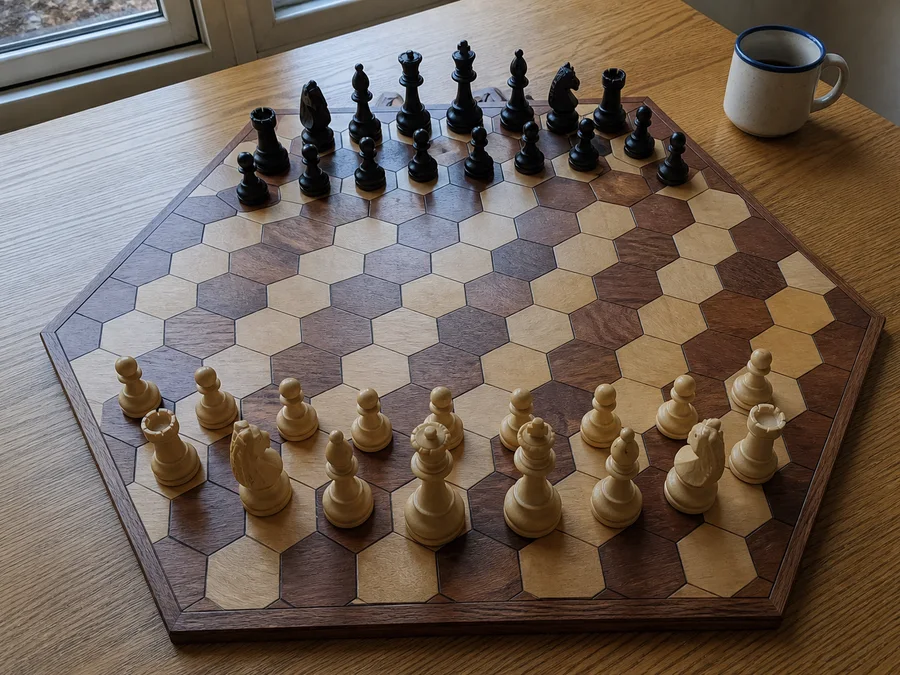
How pieces move
The broad idea is still familiar: the king moves one step, the queen is the most flexible piece, the rook uses straight lines, the bishop uses diagonals, and the knight jumps. The difference is that a hex board gives those patterns more directions than a square board.
The king steps one cell into any of twelve neighbouring directions. The queen combines rook and bishop movement. A rook slides along six orthogonal directions without jumping. A bishop slides along six diagonals. A knight leaps to twelve fixed cells and may jump over pieces.
Captures work as in square chess: land on an enemy piece to remove it. The king may not move into check or remain on an attacked cell.
If you cannot yet see where a bishop or knight can go, tap it and use the highlights. On this board, that is often the fastest way to learn the pattern.
Pawns, en passant, and promotion
A pawn advances one cell straight ahead. It captures on the two 60° forward diagonals and never by advancing along them. Any pawn still on a friendly starting cell may step two hexes. After that double step, an adjacent enemy pawn may capture en passant: if Black plays c7-c5, a White pawn on b5 may capture onto c6.
A pawn that reaches the end of its file promotes. This site promotes to a queen automatically. There is no castling.
Checkmate and stalemate
Checkmate wins. The unusual part is stalemate: if a player has no legal move and is not in check, Gliński does not score a draw. Instead, the side that has just moved wins. Players may still agree a draw, and a long run without a capture or pawn move can also be scored as a draw on this site.
How to play here
Check the status bar for the side to move, tap one of that side's pieces, then tap a highlighted cell. Against AI you may sit White or Black, and hints follow the current level.
The easiest way to learn is to play one full game with the highlights on: tap a piece, see what opens up, and choose from there. If a piece shows no destination you want, cancel and try another. Once the move patterns start to feel natural, continue to the hexagonal chess strategy guide.
Hexagonal Chess Rules FAQ
Which side moves first in hexagonal chess?
White always moves first. Against AI you may choose White or Black; if you choose Black, the AI makes the opening move.
Why does each side have three bishops?
Hex cells come in three colours. Because a bishop stays on one colour for the whole game, each side needs three bishops to cover the board.
Can a pawn advance diagonally, as in square chess captures?
No. Pawns only move straight ahead. The diagonal is used for captures, and the double step is also two cells straight ahead.
Is stalemate a draw?
No. Under Gliński scoring, if the opponent has no legal move and is not in check, the side that has just moved wins.
Can I still play if I cannot picture every move yet?
Yes. The site highlights legal destinations for the piece you tap. Most beginners learn the board faster by playing with those highlights first, then returning to the written rules once the patterns feel familiar.
