
This page is not about abstract principles. It gives beginners a practical order of checks they can carry straight into a game. If the rules are still unclear, read the hexagonal chess rules; once you can start moving pieces, the habits below will help more than memorising openings.
Drop these habits first
Players coming from square chess usually lose to habit before they lose to calculation. The first habit is assuming a pawn can somehow keep drifting diagonally forward. The second is remembering only two bishop colours and leaving the third unattended. The third is grabbing a pawn without checking whether that move opens a long line for the opponent.
So make three checks before every move: is the pawn still moving straight ahead; are all three colours still covered; and does this move open a long file or diagonal for the other side? That routine will stabilise your games faster than trying to remember named openings.
The third bishop changes the opening
A square board has two colours; a hex board has three. Leave one colour unattended and an enemy bishop can run the whole diagonal. In the opening, do not ask only which bishop can develop first. Ask whether all three colours are still watched.
The practical test in the first few moves is simple: do all three bishops have a path, and will a central pawn double step trap one of them behind your own structure? Beginners rarely misuse bishops because bishops are weak here. They usually misuse them by sealing one colour themselves.
Check the files before captures
A rook has six long directions, and an open file is often worth more than winning a pawn. Many beginners lose the same way: they take the free material first, only to realise that the exchange opened a lane straight into their own position.
Before you capture, look at the cleanest lines near both kings. If one move lets your rook or queen see much farther down the board, that usually matters more than a small gain. On a hex board, line control is often the skeleton of the whole position.
The double step is a resource
Any pawn still on its starting cell may step two hexes, but that does not mean every pawn should use the option at once. A double step creates en passant and changes several lines at the same time. Before you push, check whom it frees and whom it exposes.
The most valuable option to keep is often the central pawn double step. If you delay it, you keep both tempo and space in reserve. Once you see where the opponent's three bishops are aimed, you can decide whether the central break helps you or simply opens the board for them.
How to practise usefully
Do not try to train every idea at once. Pick one AI level and give yourself one job only: keep all three colours covered, or check for en passant before every double step. Three focused games like that usually teach more than ten casual ones.
After each game, do not review only the result. Replay two moments: the move that opened a long line, and the move that made a bishop or rook lose purpose. If you can identify those turning points, you are much less likely to repeat them. Hints follow the current AI level, which makes them a good comparison against your own judgement.
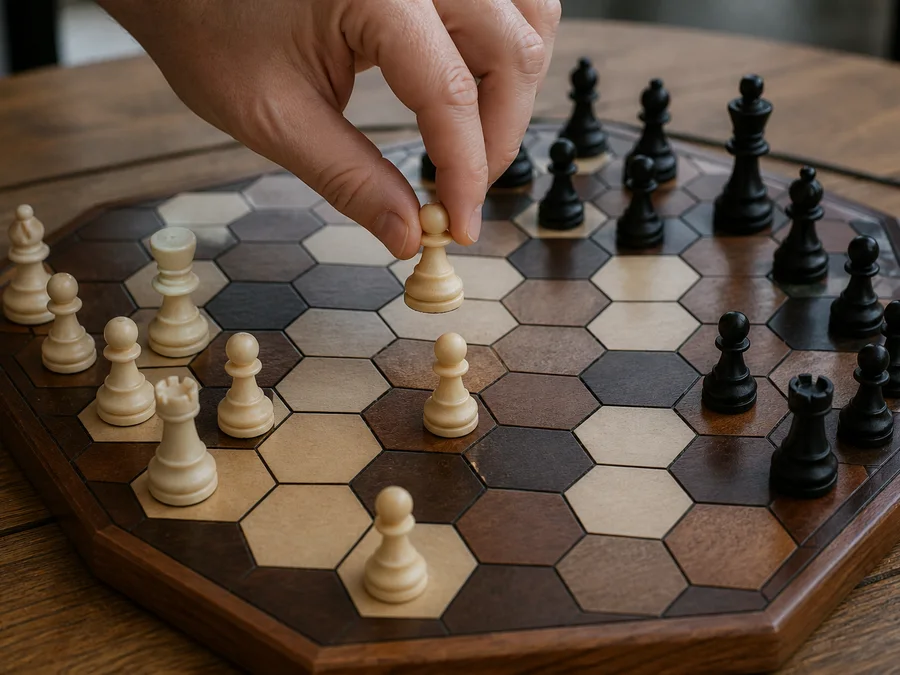
Hexagonal Chess Strategy FAQ
Which pawn should I move first?
There is no single answer. First make sure all three bishops have a path, then decide whether the central pawn should take its double step. If you rush every pawn two cells, you often block your own diagonals and hand over en passant chances.
Should I trade bishops early?
Check both colour and activity. Removing the opponent's bishop of one colour leaves your own bishop alone on that diagonal. Trading an active bishop for a blocked one is usually a loss.
Do hints secretly use the strongest AI?
No. Hints use the same search and time limit as the AI level currently selected in the sidebar.
Can I reuse square-chess openings?
The sense of development transfers; the exact moves do not. The extra directions and the third bishop make square-board book lines miss the cells. It is usually better to learn colour coverage and line control first.
What is the single best thing for a beginner to train first?
Train yourself to check lines before you move. If you stop opening files carelessly, your position usually survives much longer. Then add the other two checks: keep all three colours covered, and look at the consequences before every double step.
